
Texas Public Information Act
The Texas Public Information Act is in Government Code Chapter 552. The Act gives the public a broad right to inspect, copy, or receive public records held by county agencies. It also lists exceptions for confidential and sensitive items. Texas attorney general decisions interpret close calls when a county wants to withhold. See capitol.texas.gov for the full text.
The Act sets a default of openness, but it does not override other confidentiality statutes such as juvenile law, adoption law, expunction orders, or mental-health privacy rules. The county's role is to apply the Act to its own non-judicial records and to point requesters to the right office when the request lands in the wrong place.
What Records the County Maintains
The county keeps a wide set of records across many offices. Court records sit with the clerks and follow court rules. Sheriff records, budgets, contracts, and meeting agendas follow the open-records process. Specialty Courts pages, county judge information, and department contacts are already posted on the county site.
The county Specialty Courts page is a useful gateway to programs that produce their own public information.

The Specialty Courts overview at mclennan.gov/1094 covers Veterans Treatment Court, Mental Health Court, Recovery Court, and partner programs.
Recovery Court, formerly DWI and Drug Court, is one of those programs. It focuses on criminal thinking and prosocial skills to help adult defendants maintain sobriety.
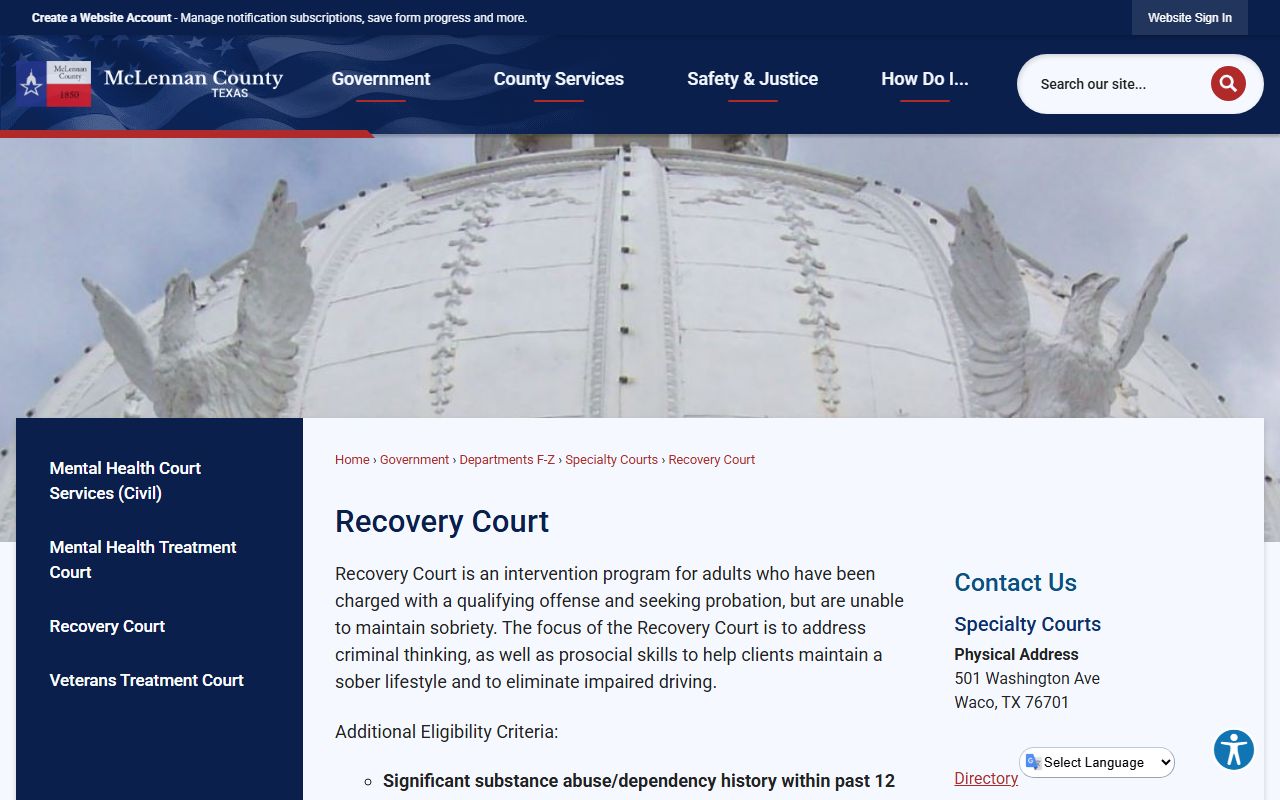
The page at mclennan.gov/1095 lists eligibility and contact information for the Recovery Court program.
Veterans Treatment Court serves defendants whose military service tied into the charge and requires proof of veteran status and a DD-214.

The county page at mclennan.gov/1097 covers eligibility, VA-care requirements, and the DD-214 rule.
The Mental Health Treatment Court asks for a serious mental-health diagnosis and current care with a local mental-health authority.

The page at mclennan.gov/1289 lists eligibility criteria and the contact for the Specialty Courts director.
How to File a Public Records Request in McLennan County
The Sheriff's Office uses a GovQA portal to take open-records requests. Other departments accept requests by letter, email, or fax to the office holding the records. The Act does not require a special form, but a clear, narrow request gets a faster answer.
The Sheriff page has direct links to its open-records process and other records resources.

The Sheriff's Office at mclennan.gov/185 links to Crimestoppers, the inmate list, mugshots, visitation, mail rules, and the open-records GovQA portal.
- Identify the office that holds the records.
- Write a clear request that names the records, the date range, and the format you want.
- Send the request through GovQA for the Sheriff, or by mail, email, or fax to the right department.
- Watch for any cost estimate the office sends back.
- Pay any fee and wait for the records or an attorney general decision.
- If your request is denied, ask the office to seek an attorney general ruling.
Public Records Request Form Fields
The county does not require a fixed form, but a complete request usually includes the same key fields. The table below sums up what to put in a request to make it easy for the office to act on.
| Field | What to Include |
|---|---|
| Requestor Name and Contact | Full name, mailing address, phone, and email. |
| Records Sought | Specific records by date range, subject, person, or topic. |
| Format Preferred | Paper, electronic file, certified copy, or inspection only. |
| Office Addressed | The department that holds the records. |
| Payment Authorization | An agreed cap on charges if a fee is needed. |
| Signature and Date | Signed and dated request. |
Response Timelines
The Texas Public Information Act sets a default response window, with extra time for clarifying or for handling exceptions through the attorney general process. Counties usually answer within about ten business days, though complex requests can take longer if the office must redact records or get an attorney general ruling. The Sheriff's GovQA portal acknowledges requests automatically.
Public Records Fees in McLennan County
The Act allows counties to charge for copies, programming, and certain labor. Routine paper copies are usually $1 or less per page, with certified copies adding a flat fee. Larger requests that need programming or extensive search may carry hourly rates. The exact fee depends on the office and the size of the request.
| Item | Amount |
|---|---|
| Plain copy per page (county clerk) | $1 |
| Certification fee | $5 |
| District Clerk plain or certified copy | $1 per page |
| District Clerk search if cause number unknown | $5 |
| Large or programmed requests | Quoted hourly under the Act |
The County Courts at Law page also lists contact info and FAQs for cases handled at that level.
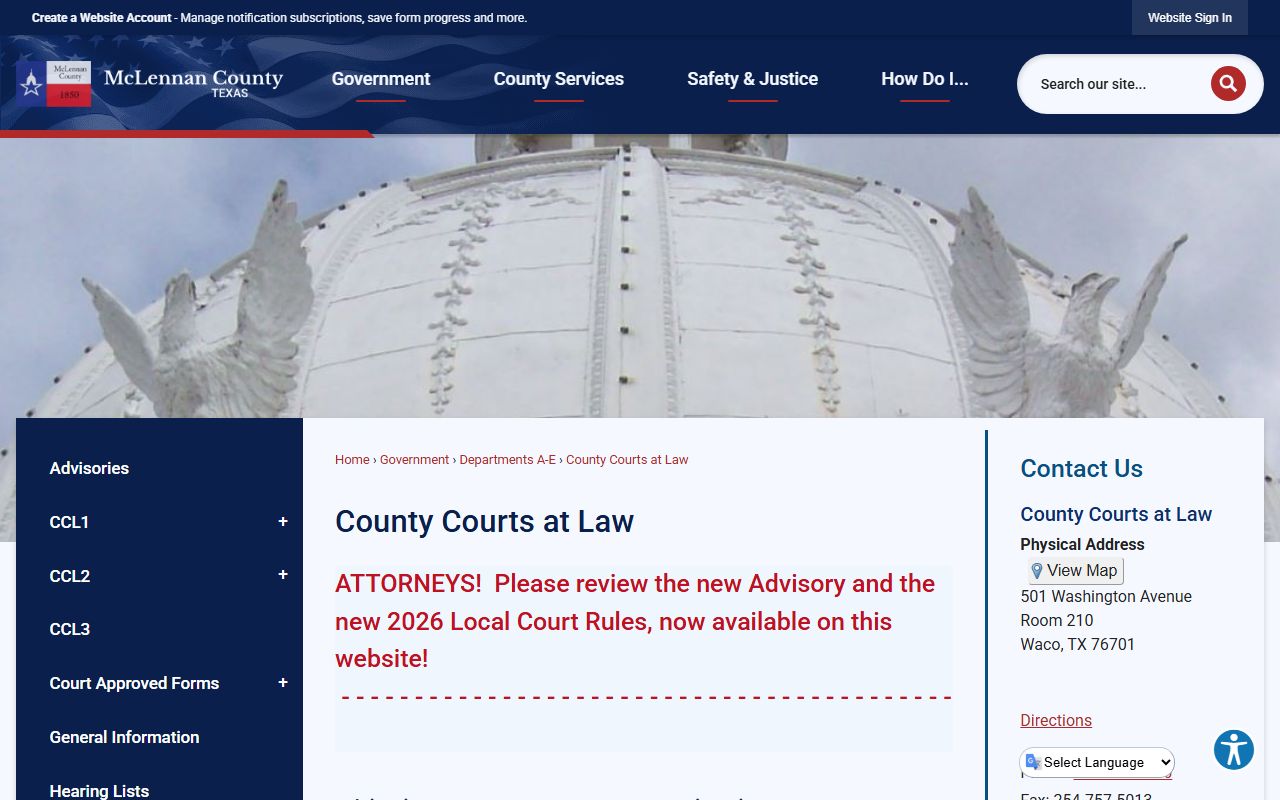
The page at mclennan.gov/264 covers room numbers, local rules, and FAQs for county-court cases that often appear in public-records requests.
Records That Are Exempt
The Act lists exceptions. Government Code section 552.108 protects certain law-enforcement and prosecutorial information when release would interfere with detection, investigation, or prosecution. Section 552.130 protects driver license and motor-vehicle data. Section 552.136 covers credit-card and access-device numbers. Section 552.140 limits public release of military discharge records for a statutory period. Juvenile, adoption, expunction, and nondisclosure rules also override the default of openness for the records they cover.
If Your Request Is Denied
When a county wants to withhold a record, it can ask the Texas Attorney General for a ruling. The AG issues open-records decisions that guide both the requester and the office. If you think the office is wrong, you can also push back in writing and ask the office to either release the record or get an AG ruling. Persistent disputes can become a lawsuit.
The county side has duties on a denial too. The office must tell the requester in writing within ten business days that it is asking for an AG decision, and it must list the parts being withheld in a clear way. The AG often issues a decision within several weeks. Many denials get resolved this way without a lawsuit, since both sides usually want a clear answer rather than a court fight.
Local legal aid resources can help if a request stalls or a fee dispute arises. Lone Star Legal Aid at 254-756-7944 is the main civil legal aid referral for low-income requestors. The State Bar Lawyer Referral Service at 800-252-9690 is another route for finding counsel. Texas Law Help and the Texas State Law Library self-help portal also run state-level guides on open-records requests, fee challenges, and AG-letter responses.